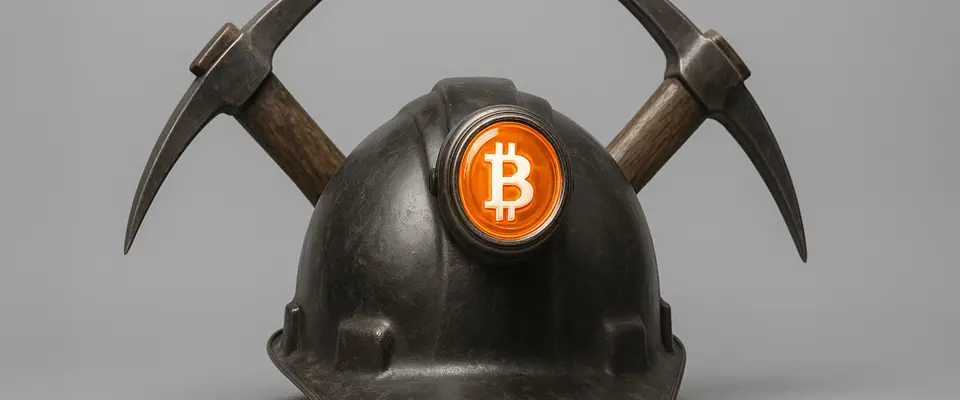
Bitcoin mining is the process by which new bitcoins are created and transactions are securely added to the blockchain, Bitcoin’s decentralized public ledger. This process involves miners using powerful computers to solve complex mathematical puzzles - a mechanism known as Proof of Work (PoW). Mining plays a critical role in securing the network, validating transactions, and controlling the issuance of new bitcoins.
The Mining Process Step-by-Step
When a Bitcoin transaction is made, it is initially unconfirmed and sits in a space called the mempool—essentially a waiting area for transactions. Miners collect these pending transactions and group them into a candidate block, prioritizing those with higher fees to maximize their potential reward.
Next, miners construct a block header which includes:
The hash of the previous block in the chain
The Merkle root, a combined hash of all transactions in the block
A timestamp of the current time
The network difficulty target, which sets how hard the mining puzzle is
A nonce, an arbitrary number miners change to find a valid hash
Miners repeatedly alter the nonce and hash the block header using the SHA-256 hashing algorithm. The goal is to find a hash output that is below the difficulty target - a string with a certain number of leading zeros. This requires massive computations and energy as the likelihood of success on each attempt is extremely low.
Once a miner finds a valid hash, the block is broadcasted to the network and other nodes verify the solution. When verified, the block is added to the blockchain, and the transactions within it are confirmed as settled.
Rewards for Mining
The successful miner receives a block reward of newly minted bitcoins plus fees from the transactions included. As of 2025, the block reward is 3.125 BTC, halving approximately every four years to regulate supply. Transaction fees provide an additional income stream and incentivize miners to continue securing the network.
Mining as an Individual
In the early days, anyone with a computer could mine Bitcoin. Today, mining requires specialized hardware known as ASICs (Application-Specific Integrated Circuits). These machines perform hashing at extremely high speeds measured in terahashes per second (TH/s). Due to the high difficulty and costs of electricity and equipment, solo mining is less common as the chances of successfully mining a block alone have decreased dramatically.

Mining Pools Explained
To increase the likelihood of earning rewards more consistently, many miners join mining pools. A mining pool is a collective of miners who share their computational power over the network. When the pool successfully mines a block, the rewards are distributed among participants proportionally based on the computing power they contributed.
Mining pools reduce the randomness of rewards and provide steady payouts, making participation more feasible for small or medium-scale miners. However, joining a pool means sharing the rewards instead of claiming the entire block reward solo.
Key Points on Mining Pools
Pools coordinate hashing efforts and combine miners’ power for better success odds
Participants receive rewards proportional to their contributed hash rate
Pools charge fees (usually a small percentage of rewards) for their service
Large pools can control a significant share of Bitcoin’s total hash rate, raising decentralization concerns
Mining Network Difficulty and Adjustments
The Bitcoin network automatically adjusts its mining difficulty approximately every two weeks to ensure new blocks are mined about every 10 minutes regardless of total network power. This self-regulating mechanism maintains consistent issuance of bitcoins and network security.
Bitcoin mining is a sophisticated and competitive process that has evolved from simple CPU mining to highly specialized ASIC operations, often collaborating in pools to share rewards. Both individual miners and pools collectively ensure Bitcoin’s blockchain remains secure, trusted, and operational.
09 August 2025
Topic:
Mining
Bitcoin Mining FAQs
Q. What is Bitcoin mining?
Bitcoin mining is the process of creating new bitcoins and securing the blockchain by solving complex mathematical puzzles using the Proof of Work (PoW) mechanism.
Q. How does the mining process work step by step?
Pending transactions wait in the mempool, miners group them into candidate blocks, build a block header, and repeatedly hash it to find a valid solution below the difficulty target. Once found, the block is added to the blockchain.
Q. What is the purpose of mining in the Bitcoin network?
Mining confirms transactions, secures the network, and controls the issuance of new bitcoins through block rewards.
Q. How is the block reward determined and what is it currently?
The block reward is the number of new bitcoins miners receive for mining a block. As of 2025, it is 3.125 BTC, halving about every four years.
Q. What hardware do you need for mining Bitcoin?
Today, miners require specialized hardware called ASICs (Application-Specific Integrated Circuits) for competitive hashing speeds (TH/s).
Q. What are mining pools and why are they important?
Mining pools are groups of miners pooling resources for a higher chance of consistent rewards, which are shared proportionally among participants.
Q. How are transaction fees included in mining rewards?
In addition to the block reward, miners earn transaction fees paid by users whose transactions are included in the block.
Q. How does mining difficulty adjust and why?
The network adjusts mining difficulty about every two weeks to ensure blocks are mined roughly every 10 minutes, balancing network hash power and issuance rate.
Q. Is solo mining still possible?
Solo mining is possible but extremely challenging due to competition from large pools and high hardware requirements, making it rare for individuals today.
Q. What are decentralization concerns around mining?
Large mining pools controlling significant hash power may impact Bitcoin's decentralization. The network relies on a broad distribution of miners for security and censorship resistance.